✨ How To French Braid Your Own Hair For Beginners Tutorials
Learning to French braid your own hair can seem like a daunting task. I remember countless frustrating attempts, with my arms aching and the back of my head feeling like an impossible puzzle.
But with the right approach and a bit of patience, it’s absolutely achievable. This guide breaks down the process into simple, manageable steps, drawing on my own trial-and-error journey to help you master it.

Quick Overview
French braiding your own hair is a rewarding skill that adds elegance to any look. You’ll learn the core technique of adding hair into a traditional braid, working your way down your head.
- Time needed: 30-45 minutes for your first few attempts, 10-15 minutes with practice.
- Difficulty: Beginner, with patience required for coordination.
- What you’ll need: Hairbrush, fine-tooth comb, hair ties, a good mirror (or two), a spray bottle with water (optional).
Step-by-Step Instructions
Step 1: Gather Your Tools & Prep Your Hair
Before you begin, make sure all your tools are within easy reach. A good setup minimizes frustration during the braiding process.
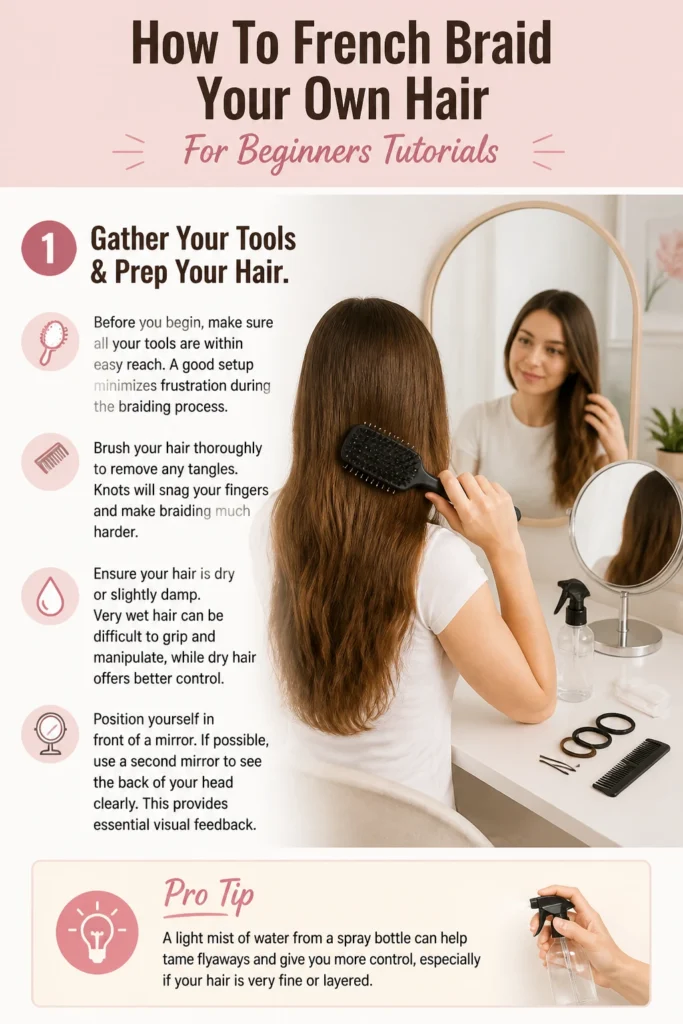
Brush your hair thoroughly to remove any tangles. Knots will snag your fingers and make braiding much harder.
Ensure your hair is dry or slightly damp. Very wet hair can be difficult to grip and manipulate, while dry hair offers better control.
Position yourself in front of a mirror. If possible, use a second mirror to see the back of your head clearly. This provides essential visual feedback.
Pro Tip: A light mist of water from a spray bottle can help tame flyaways and give you more control, especially if your hair is very fine or layered.
Step 2: Find Your Starting Point
The foundation of your French braid determines its overall look and placement. Choose a spot that feels natural and comfortable.
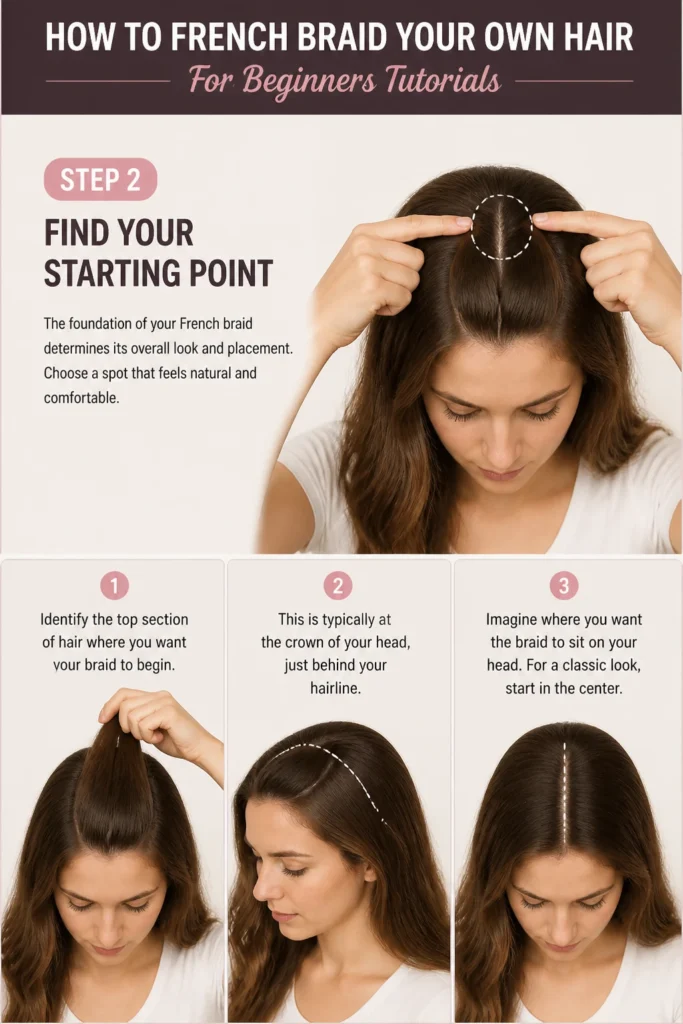
Identify the top section of hair where you want your braid to begin. This is typically at the crown of your head, just behind your hairline.
Imagine where you want the braid to sit on your head. For a classic look, start in the center.
Step 3: Divide Your First Section
This initial division sets up the core of your braid. Precision here helps ensure an even braid from the start.
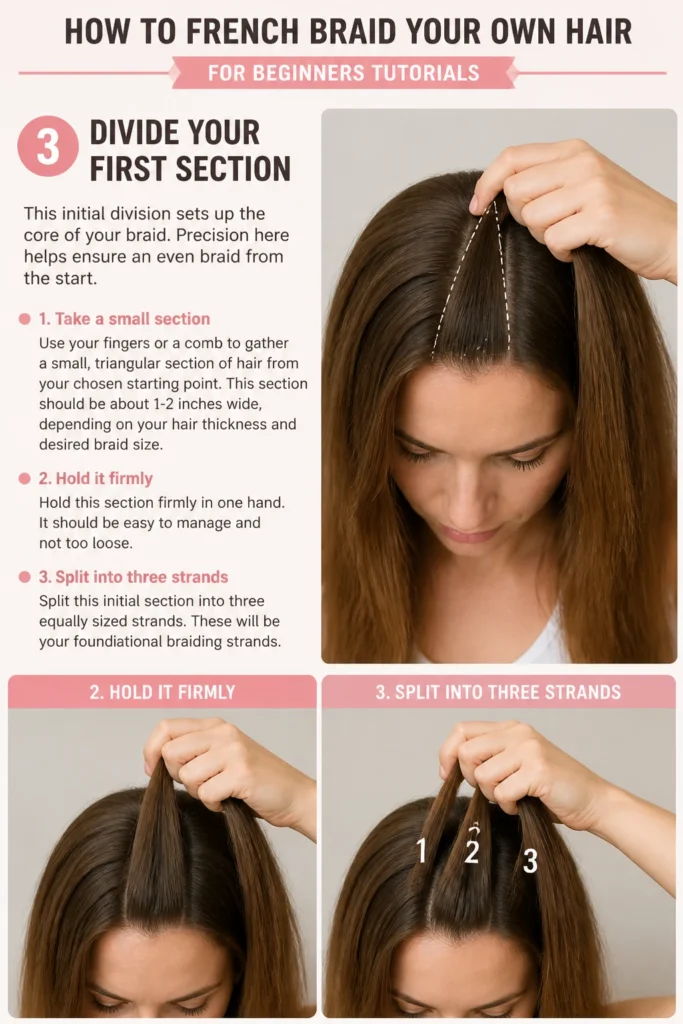
Use your fingers or a comb to gather a small, triangular section of hair from your chosen starting point. This section should be about 1-2 inches wide, depending on your hair thickness and desired braid size.
Hold this section firmly in one hand. It should be easy to manage and not too loose.
Split this initial section into three equally sized strands. These will be your foundational braiding strands.
Step 4: Begin The Basic Braid
You’ll start with a few crosses of a standard three-strand braid. This establishes the initial structure before adding new hair.
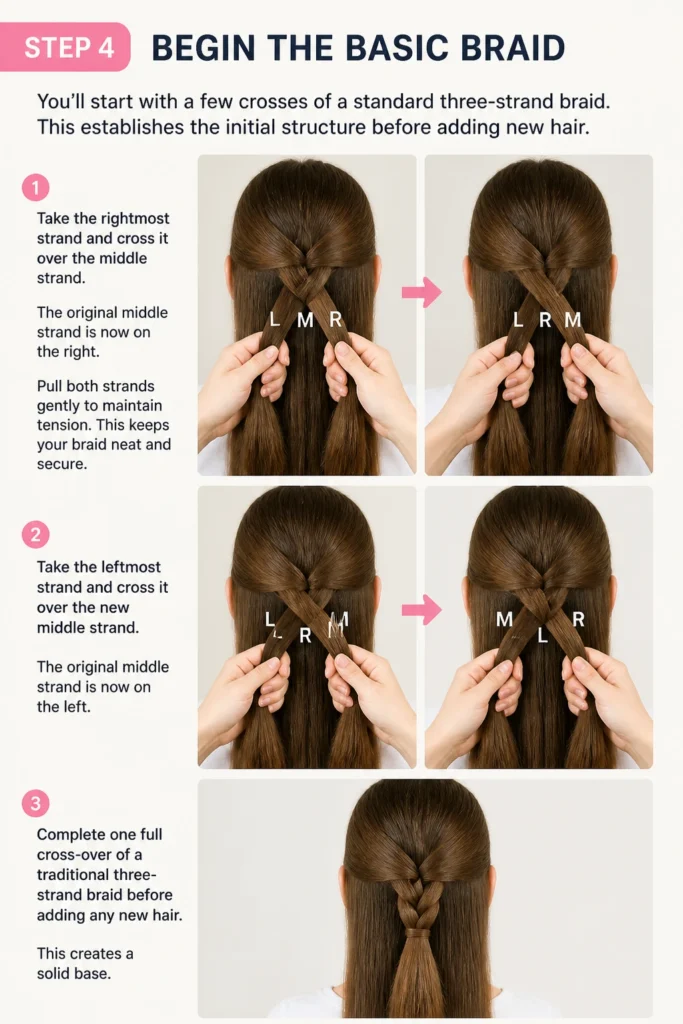
Take the rightmost strand and cross it over the middle strand. The original middle strand is now on the right.
Pull both strands gently to maintain tension. This keeps your braid neat and secure.
Take the leftmost strand and cross it over the new middle strand. The original middle strand is now on the left.
Complete one full cross-over of a traditional three-strand braid before adding any new hair. This creates a solid base.
Step 5: Add Hair From The Sides
This is the defining technique of a French braid. Mastering this step is crucial for success.
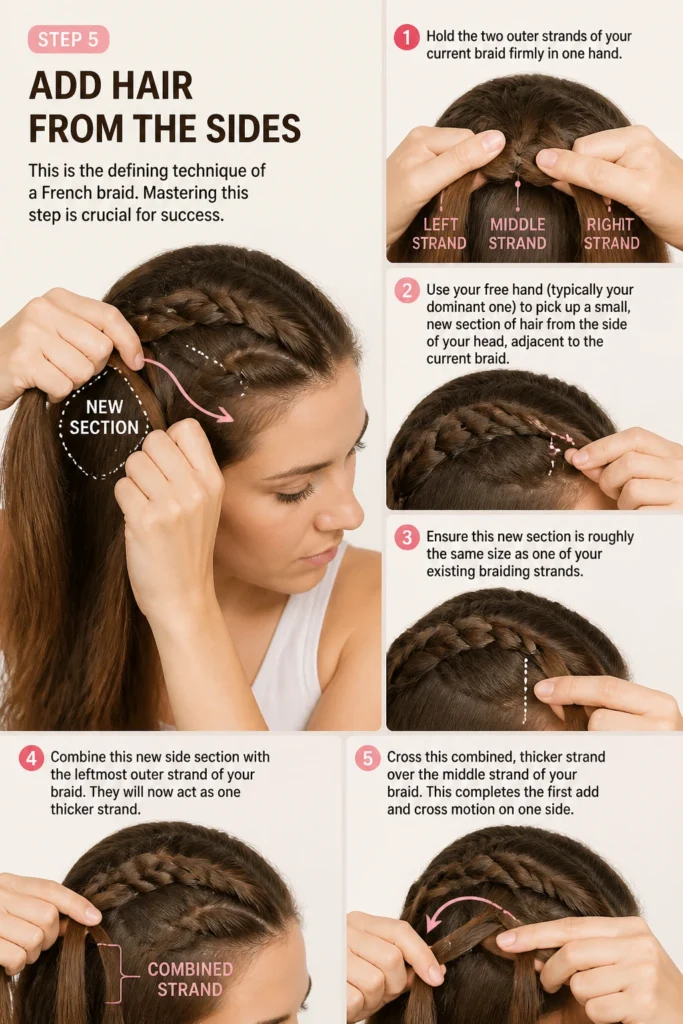
Hold the two outer strands of your current braid firmly in one hand. Use your index finger and thumb to keep them separate.
Use your free hand (typically your dominant one) to pick up a small, new section of hair from the side of your head, adjacent to the current braid.
Ensure this new section is roughly the same size as one of your existing braiding strands. Consistency is key for a uniform braid.
Combine this new side section with the leftmost outer strand of your braid. They will now act as one thicker strand.
Cross this combined, thicker strand over the middle strand of your braid. This completes the first “add and cross” motion on one side.
Step 6: Continue Adding & Braiding
Repeat the adding process, alternating sides as you work your way down your head. This builds the French braid gradually.
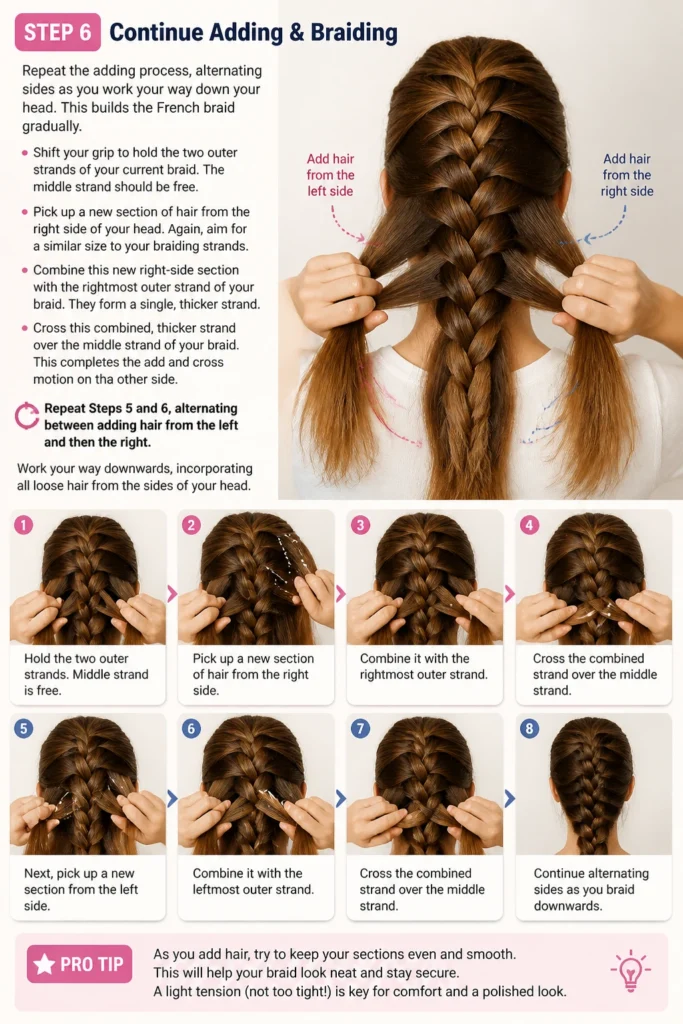
Shift your grip to hold the two outer strands of your current braid. The middle strand should be free.
Pick up a new section of hair from the right side of your head. Again, aim for a similar size to your braiding strands.
Combine this new right-side section with the rightmost outer strand of your braid. They form a single, thicker strand.
Cross this combined, thicker strand over the middle strand of your braid. This completes the “add and cross” motion on the other side.
Repeat Steps 5 and 6, alternating between adding hair from the left and then the right. Work your way downwards, incorporating all loose hair from the sides of your head.
Pro Tip: As you add hair, try to keep your hands close to your head. This helps maintain a tighter, neater braid and prevents it from becoming loose or puffy.
Step 7: Finish With a Regular Braid
Once all the hair from the sides is incorporated, transition to a standard braid. This secures the French braid structure.
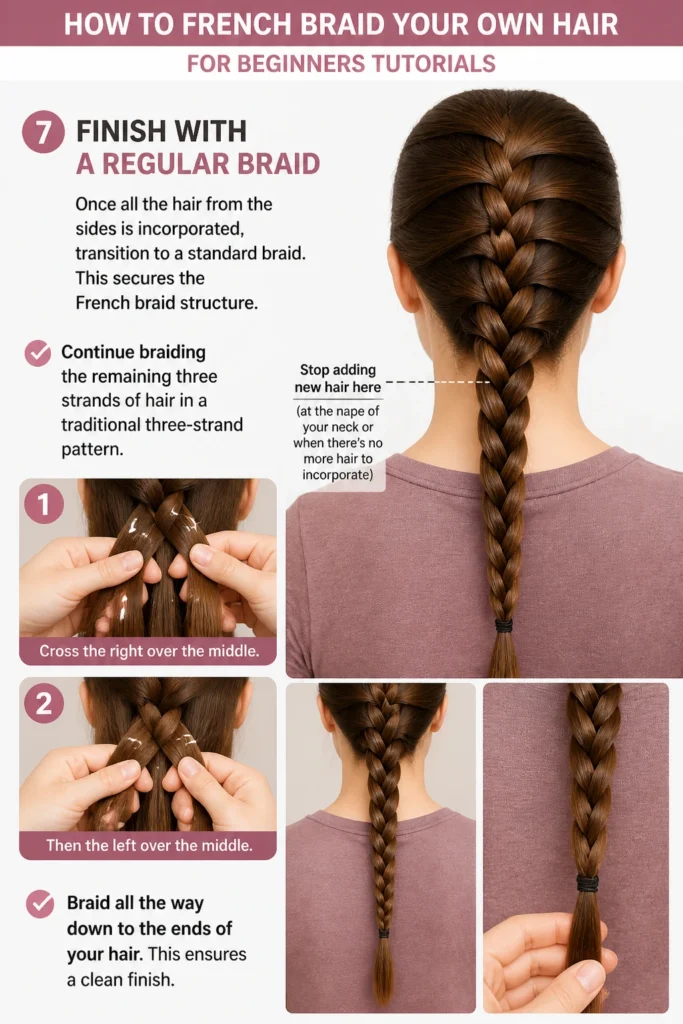
Stop adding new hair from the sides when you reach the nape of your neck, or when there’s no more loose hair to incorporate.
Continue braiding the remaining three strands of hair in a traditional three-strand pattern. Simply cross the right over the middle, then the left over the middle, without adding any new sections.
Braid all the way down to the ends of your hair. This ensures a clean finish.
Step 8: Secure & Style
The final touches make all the difference, securing your hard work and perfecting the look.
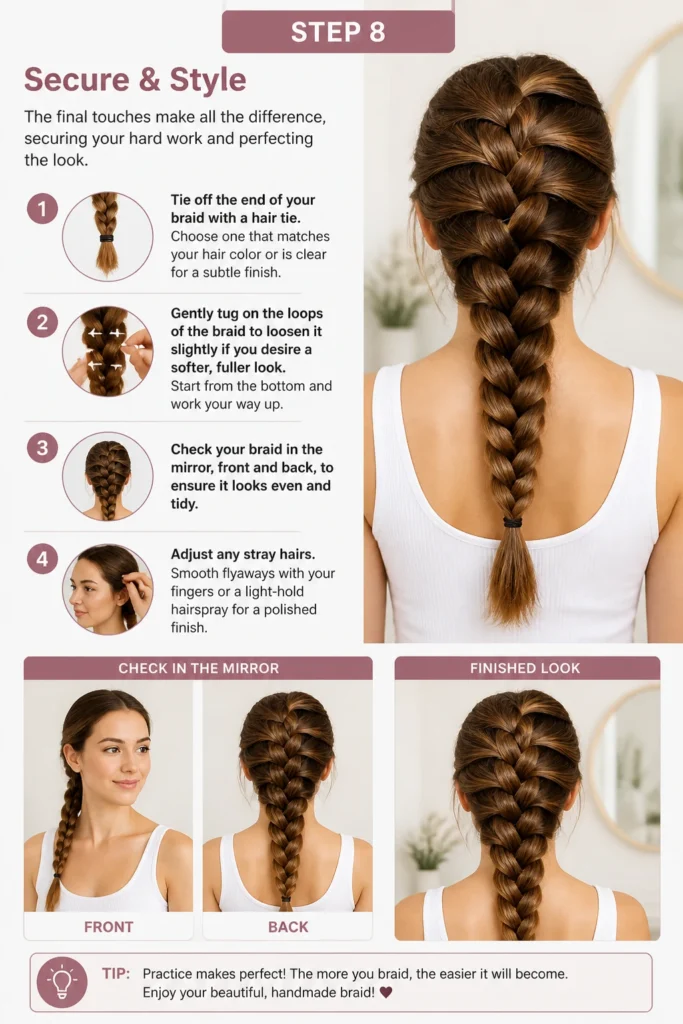
Tie off the end of your braid with a hair tie. Choose one that matches your hair color or is clear for a subtle finish.
Gently tug on the loops of the braid to loosen it slightly if you desire a softer, fuller look. Start from the bottom and work your way up.
Check your braid in the mirror, front and back, to ensure it looks even and tidy. Adjust any stray hairs.
Common Mistakes to Avoid
Knowing what pitfalls to sidestep can save you a lot of frustration and lead to a much better braid.
Uneven Sections
Gathering inconsistent amounts of hair for each new addition is a common error. This often results in a lopsided or bumpy braid, where one side looks thicker or looser than the other. To correct this, always aim to pick up roughly the same amount of hair each time you add a new section. Using a fine-tooth comb to neatly separate sections can greatly improve consistency.
Losing Tension
A loose grip throughout the braiding process is a surefire way for your braid to unravel or look messy. If your braid feels too slack, it will lack definition and fall apart quickly. Focus on maintaining a firm, consistent tension on all three strands as you cross them over and add new hair. Your hands should stay close to your head, pulling gently but steadily.
Skipping Prep
Trying to braid hair that is tangled, matted, or full of product residue makes the entire process incredibly difficult. Your fingers will snag, strands will pull unevenly, and the braid will look messy. Always start with thoroughly brushed, detangled hair. A light mist of water can also help smooth the hair and make it more manageable, especially for beginners.
Not Using a Mirror
Attempting to French braid the back of your head purely by feel is extremely challenging for a beginner. Without visual feedback, it’s almost impossible to ensure even sections and proper placement. Always use a primary mirror to see the front and sides, and ideally a second mirror or a well-placed phone camera to view the back of your head. This allows you to make real-time adjustments.
Troubleshooting
Even with the best instructions, you might encounter a few snags. Here’s how to tackle common problems.
My braid is loose/falling apart
This is almost always a tension issue. Your grip might be too loose, or you might not be pulling the strands taut enough as you cross them over. Try again, focusing on keeping your fingers closer to your head and applying consistent, gentle pressure on each strand. Don’t be afraid to restart if it feels too loose early on.
I can’t reach the back of my head
Arm fatigue and awkward angles are common challenges for beginners. Practice is key here; your muscle memory will improve over time. Consider starting your braid a bit lower on your head initially, or try braiding with your head tilted forward slightly, which can make the back more accessible. Using two mirrors, or even filming yourself, can also help you see what you’re doing.
My sections are uneven
Uneven sections lead to a lopsided braid. This often happens when you’re grabbing hair haphazardly. To fix this, use a fine-tooth comb to neatly separate each new section of hair before adding it to your braid. Start with smaller, more manageable sections until you get a feel for consistency. Don’t rush this part; precision here pays off.
Key Takeaways
- Practice makes perfect: Don’t get discouraged by initial attempts; consistency is key.
- Prep your hair: Always start with detangled, smooth hair for easier braiding.
- Maintain even sections: Consistent section sizes lead to a neat, balanced braid.
- Apply consistent tension: A firm, even grip prevents the braid from unraveling.
- Utilize mirrors: Visual feedback is crucial for seeing what you’re doing, especially at the back.
- Be patient with yourself: Learning a new skill takes time and perseverance.
Frequently Asked Questions
Can I French braid wet hair?
Yes, you can French braid wet or damp hair. Some people find it easier to work with damp hair because it’s less prone to flyaways and can hold its shape better. However, make sure it’s not soaking wet, as this can make it harder to grip and can also lead to hair damage when drying.
How do I make my French braid tighter?
To make your French braid tighter, focus on maintaining consistent tension throughout the entire process. Pull each strand taut as you cross it over, and ensure your hands stay close to your scalp. Smaller, neater sections also contribute to a tighter, more defined braid.
What if my hair is layered?
Layered hair can be a bit trickier, as shorter layers might poke out. To manage layers, ensure your hair is slightly damp to help smooth them down. You can also use a small amount of styling product like a light gel or mousse on the shorter layers before braiding. Keep your sections small and your tension firm to help secure those shorter pieces.
How long does a French braid last?
A well-done French braid can last anywhere from a few hours to a full day, or even overnight. The longevity depends on your hair type, how tightly it’s braided, and your activity level. Tighter braids on slightly damp hair tend to last longer.
Our Top Recommended Finds
- Fine-Tooth Comb: Essential for precise sectioning, ensuring your braid is neat and even from start to finish.
- Clear Hair Ties: Blend seamlessly with any hair color, providing an invisible finish to your beautifully braided hair.
- Detangling Brush: Prepares your hair by gently removing knots, making the braiding process smoother and pain-free.
Your Braid Journey Begins Now!
You’ve taken the first step toward mastering the elegant French braid. This skill, once intimidating, is now within your grasp. Remember that every beautiful braid starts with a single, patient attempt.
Don’t be discouraged if your first few tries aren’t perfect; that’s part of the learning process. Keep practicing, and you’ll soon find your rhythm. Once you’re comfortable, you might even explore variations like Dutch braids or French braiding two pigtails. Grab your comb and hair ties, and start braiding today!